Funny, I haven’t even been able to try an UMPC (Origami) device yet and now Microsoft talk about Next Generation called Vistagami.
Interesting things about Vistagami:
- Hopefully, Lower prices, $500 is the price goal
- Vistagami devices will run Windows Vista, rather than XP
- As for Vistagami, Microsoft is still aiming to have devices ready by the time Vista ships early next year (January 2007).
I hope they are also able to fix the lack of all-day battery life, it is critical I believe!
Wednesday, May 31, 2006

Monday, May 22, 2006
what I would have to next JavaOne
a UMPC, they look very nice, check this or perhaps a Nokia 770 (you have to buy a bluetooth keyboard) or something else…
I am tired of bring my laptop pc to JavaOne, to heavy and the battery time is only 3 h.
I need something else so please Nokia (or any other company) fix it to next JavaOne, a handheld device with a keyboard like the UMPC!
My Windows XP installation crash 05.00 pm the day before departure to JavaOne, I had to reinstall my laptop pc, I finish the installation 11.30 pm and 03.30 I went up to go to JavaOne
I am tired of bring my laptop pc to JavaOne, to heavy and the battery time is only 3 h.
I need something else so please Nokia (or any other company) fix it to next JavaOne, a handheld device with a keyboard like the UMPC!
My Windows XP installation crash 05.00 pm the day before departure to JavaOne, I had to reinstall my laptop pc, I finish the installation 11.30 pm and 03.30 I went up to go to JavaOne
Continue report from the NetBeans Software and JavaOne2006 conference in San Francisco
I join the NetBeans Software Day at the 2006 JavaOne Conference and JavaOne conference.
Some more interesting things from those events:
- The JavaOne conference of course had lot of session about Java EE 5.0 that was finishing some days before the conference. It is funny it was not a big happing during JavaOne that they released this huge improved version of Java EE. I think it was because developers have waiting so long for this release and most of us know a lot about this release already. Anyway I went for some EJB 3 sessions and I must say it look really nice, include in EJB 3.0 is also a new Java Persistence API (JPA). There was not so much talk about Hibernate, look to me EJB 3.0 have been accepted as a good alternative instead of using Hibernate.
- Java ME/CDC1.1 is now really hot, must of us developer working in the Java Mobility area has waiting for that a long time. At JavaOne it was showed clearly with:
1) This the first release of a SavaJe based phone called Jasper S20, the first commercial handset to run all applications in Java technology
2) Netbeans support Java ME/CDC with this new NetBeans Mobility Pack 5.5 for CDC Preview
3) Sun released the Sun Java Wireless toolkit is for CLDC
4) Company like Nokia and Motorala will soon release more devices supporting the Java ME/CDC platform. I believe there will come many Java ME/CDC devices during 2007.
- Interesting is also there will soon come some new GUI toolkit, that will replace AWT for the Java ME/CDC platform: AGUI toolkit (JSR-209) and eswt (Nokia and IBM promote it a lot). Nokia talk about eSWT for Next Generation Java in Nokia platforms, but eSWT is not a JCP standard.
- Sun promoted the Netbeans platform very hard during JavaOne, in keynotes and in technical session and in the JavaOne Pavilion. Sun strategy is to move all there products into the Netbeans platform and I think they will have success with this.
- I became interested in the Open Source database Apache Derby after I went to a technical session about Derby. I realize Derby also supports the Java ME/CDC platform and for me it is really interesting. Later I got information from a developer that have using Derby with J9 on a Pocket PC 2003, he told me:
“I have really given up on Derby as the memory footprint is just too big. You need to 8-16 Mb to really operate properly. Derby will not load a 20,000 row table with one index in 8 meg including your app, that's just doing the inserts, never mind starting to do queries!.
However, I have just the other day discovered db4o... wow this is something else! the best bit of software I have seen since google earth.
It's not an SQL database it's an Object database. Rather than me harping on about it here, take a look for yourself, it's simply amazing.
I now have my application working great, it's faster, easier and handles even bigger tables... and currently all in under 3 meg. It does take a bit of getting used to, as they is no joins. But once you do, there is no going back!
- They talked about Project Tango, SUN engineers have working with Microsoft (WCF) engineers to ensure interoperability of enterprise features in Webservices. They have now Open Source the work they have done in Tango and they called it WSIT.
- I went to a technical session about Mobile Operational Management (JSR-232), just to JavaOne they released a Public Review about it. I think this JSR will be very important for us developer in the future.
- I also went to technical session about Java Card Next generation, it was really interesting, they plan to have a webserver on the JavaCard and support access to the JavaCard with normal IP, to simplify it for developer. Really cool but this JSR will come out during 2007 and products 2008, with normal delays….2009
- AJAX was hot during JavaOne, but not for me!!I think it is time for SWING applications, with Matisse it has really get easier to develop GUI application both for Java SE and Java ME/CDC1.1 platforms.
- It look like companies supporting Open Source have easier to get attention in the JavaOne pavilion, lots of people visit sun and Jboss’s booths, but not so many people in BEA, Borland booths. Of course these company will say they support Open Source, but the main different is that they sell there products.
to be continued …..
Saturday, May 20, 2006
Report from the NetBeans Software and JavaOne2006 conference in San Francisco
I join the NetBeans Software Day at the 2006 JavaOne Conference and JavaOne conference.
Some interesting things from those events:
- I got one SavaJe phone!!, now I can start using Java ME/CDC1.1 and the new AGUI toolkit (JSR-209).
- There is also a new releases of Netbeans that support the SavaJe phone called NetBeans Mobility Pack 5.5 for CDC Preview.
- Sun announced that Jboss now have also join Netbeans
- Netbeans 5.5 beta with support for Java EE 5.0 is released.
- Netbeans subversion beta is released, it look very nice in the demo.
- There was a demo of the Jackpot module, the module adds the capability to reengineer Java source code. You are also able to add new rules easy and share with others.
- Sun promote everyone to join JCP, I thought I should join JCP, but you couldn’t do that in the JavaOne pavilion, you have to download a pdf-file and sign it and then send it as a fax. Perhaps time to fix an easier solution and using Java for that?
- There was a demo of the NetBeans Enterprise Pack, you are then able to write SOA applications using XML, BPEL, and Java web services.
- Sun also continue to open source more things like: Sun Java Studio Creator, Sun Java System Portal Server, the Business Process Execution Language (BPEL) Engine and the NetBeans Enterprise Pack, as well as Sun's Java Message System (JMS)-based message queue and Web Services Interoperability Technology (WSIT). Everything moves into the Netbeans platform, I think it is a good strategy and the Netbeans platform getting stronger!!
- MSA for CLDC (JSR-248) became in Proposed Final Draft during JavaOne, they planned to have it final in august, we will see devices with support for that during 2006Q4/2007Q1. One change was support to run on top of Java ME/CDC1.1, the reason for that was to make it easier to migrate to MSA for CDC JSR-249 when it is ready. JSR-249 first public release plans to be released 2006Q4. MSA plans in the future to be upgrade every 18 months. One other change in JSR-248 was that there will be a will two versions of the MSA, one with a subset and one with whole MSA , read more about it here at C. Enrique Ortiz' Mobility Weblog.
- The new AGUI toolkit (JSR-209) planned to be final in august.
- Sun also released a Sun Java Toolkit for CDC, Early Access, it is like what Sun Java Wireless toolkit is for CLDC, the toolkit includes the emulation environments, documentation.
- In Nokia booth they demo next release of Carbide.j, version 1.5 that will support remote debugging on the phones. It look nice and it is very good to have.
to be continued …..
Some interesting things from those events:
- I got one SavaJe phone!!, now I can start using Java ME/CDC1.1 and the new AGUI toolkit (JSR-209).
- There is also a new releases of Netbeans that support the SavaJe phone called NetBeans Mobility Pack 5.5 for CDC Preview.
- Sun announced that Jboss now have also join Netbeans
- Netbeans 5.5 beta with support for Java EE 5.0 is released.
- Netbeans subversion beta is released, it look very nice in the demo.
- There was a demo of the Jackpot module, the module adds the capability to reengineer Java source code. You are also able to add new rules easy and share with others.
- Sun promote everyone to join JCP, I thought I should join JCP, but you couldn’t do that in the JavaOne pavilion, you have to download a pdf-file and sign it and then send it as a fax. Perhaps time to fix an easier solution and using Java for that?
- There was a demo of the NetBeans Enterprise Pack, you are then able to write SOA applications using XML, BPEL, and Java web services.
- Sun also continue to open source more things like: Sun Java Studio Creator, Sun Java System Portal Server, the Business Process Execution Language (BPEL) Engine and the NetBeans Enterprise Pack, as well as Sun's Java Message System (JMS)-based message queue and Web Services Interoperability Technology (WSIT). Everything moves into the Netbeans platform, I think it is a good strategy and the Netbeans platform getting stronger!!
- MSA for CLDC (JSR-248) became in Proposed Final Draft during JavaOne, they planned to have it final in august, we will see devices with support for that during 2006Q4/2007Q1. One change was support to run on top of Java ME/CDC1.1, the reason for that was to make it easier to migrate to MSA for CDC JSR-249 when it is ready. JSR-249 first public release plans to be released 2006Q4. MSA plans in the future to be upgrade every 18 months. One other change in JSR-248 was that there will be a will two versions of the MSA, one with a subset and one with whole MSA , read more about it here at C. Enrique Ortiz' Mobility Weblog.
- The new AGUI toolkit (JSR-209) planned to be final in august.
- Sun also released a Sun Java Toolkit for CDC, Early Access, it is like what Sun Java Wireless toolkit is for CLDC, the toolkit includes the emulation environments, documentation.
- In Nokia booth they demo next release of Carbide.j, version 1.5 that will support remote debugging on the phones. It look nice and it is very good to have.
to be continued …..
Monday, May 15, 2006
Time for JavaOne!!!
I arrived on Friday to San Francisco, great to be here again, it is my 6th JavaOne.
Yesterday I went on tour “Muir Woods and Wine Country Tour”. It was a great tour with a lot of goods wines and I also liked the Muir woods with the world’s tallest trees.
But now it soon time for JavaOne, but first I will join the NetBeans Software Day at the 2006 JavaOne Conference, it is tomorrow.
See You at JavaOne and Netbeans day!!!
*****************sorry in swedish this part***************************
JavaOne, Får mig osökt att tänka på Orup... ” Nej du tar inte min Mercedes”
Nej du tar inte min JavaOne
JavaOne är min bäste vän
Du tar inte min JavaOne
Nej då kan du hälsa hem
Jag sa skjut min hund, prygla min katt, gör av med mina pengar på en lördagsnatt
Ta min fru, gör det du, men du om nån borde veta att: vill du göra mig riktigt illa
Så ta min JavaOne
Vill du åsamka mig smärta och förtvivlan utan gräns Vill du se hur mina tårar trillar, så ta min JavaOne
Yesterday I went on tour “Muir Woods and Wine Country Tour”. It was a great tour with a lot of goods wines and I also liked the Muir woods with the world’s tallest trees.
But now it soon time for JavaOne, but first I will join the NetBeans Software Day at the 2006 JavaOne Conference, it is tomorrow.
See You at JavaOne and Netbeans day!!!
*****************sorry in swedish this part***************************
JavaOne, Får mig osökt att tänka på Orup... ” Nej du tar inte min Mercedes”
Nej du tar inte min JavaOne
JavaOne är min bäste vän
Du tar inte min JavaOne
Nej då kan du hälsa hem
Jag sa skjut min hund, prygla min katt, gör av med mina pengar på en lördagsnatt
Ta min fru, gör det du, men du om nån borde veta att: vill du göra mig riktigt illa
Så ta min JavaOne
Vill du åsamka mig smärta och förtvivlan utan gräns Vill du se hur mina tårar trillar, så ta min JavaOne
Wednesday, May 10, 2006
Free database for Java ME/CDC1.1 platform?
Now when it look like there will lots of devices for the for Java ME/CDC1.1 platform in the future.
What about a free database that you could bundle with your Java ME/CDC application?
Is there anyone with support for the following platforms: Symbian 9, Microsoft Windows Mobile 5.0 (for Pocket PC) and SavaJe?
How do you bundle the application (Java App and database)?
Will it be support for that in tools like NetBeans Mobility Pack for CDC?
What about a free database that you could bundle with your Java ME/CDC application?
Is there anyone with support for the following platforms: Symbian 9, Microsoft Windows Mobile 5.0 (for Pocket PC) and SavaJe?
How do you bundle the application (Java App and database)?
Will it be support for that in tools like NetBeans Mobility Pack for CDC?
Monday, May 08, 2006
We need JSR-249, JSR-232 and JSR-246 now!!
I think it is now time for success for the Java ME/CDC1.1/Personal Profile platform1.1!!!
But we need tools and devices for the Java ME/CDC1.1/Personal Profile platform1.1 to get this success.
So far Java ME/CDC1.0/Personal Profile 1.0 had no success in this area!
You can read things like Sun - Get you finger out! We NEED a Java Handheld / VM and Open letter to SUN to produce a JRE for Pocket PC
But a month ago the NetBeans Mobility Pack for CDC appeared!!
Netbeans was already is my favorite tool for the Java ME/MIDP 2.0 platform and now they also support Java ME/PP1.1 platform. I think now Netbeans is the best Java tool for mobility developing and it is also free!!
During 2007 I hope company like SonyErcisson, HP, Nokia, Palm, DELL will start produce more devices, with support for Java ME/CDC1.1/Personal profile 1.1 platform.
But support for Java ME/CDC1.1/PP1.1 is not enough for to get this success for the Java ME/Personal Profile platform. I think devices also need to support JSR-249 (Mobile Service Architecture Advanced) , JSR-232 (Mobile Operational Management) and JSR-246 (Device Management API).
JSR-249 provides guidelines to integrate J2ME JSRs in a uniform and predictable arrangement that is customized specifically for the advanced mobile handset. It will issue clarifications on certain components if necessary and will aim at reducing the number of available options.
It should also be possible to managed devices remotely with a modular architecture that enables extensibility after manufacturing. Push out new Java application, databases, OS updates and Java updates. In case of lost of device, lock the device remotely. It should also be possible to administration of users remotely.
All major mobile phone manufacturers worked together in order to define a 'Mobile Operational Management' concept (JSR-232). The OSGi Service Platform and the OMA DM (JSR-246) specifications provide the basis for building this standard for end-to-end management of CDC-enabled mobile handsets.
But JSR-249, JSR-232 and JSR-246 are not final yet, I hope they can speed up the process to get all these important JSR in a final stage. This is really important!!
I hope to hear news about that during JavaOne 2006 and it is now close to the 2006 JavaOne Conference!!! :-)
But we need tools and devices for the Java ME/CDC1.1/Personal Profile platform1.1 to get this success.
So far Java ME/CDC1.0/Personal Profile 1.0 had no success in this area!
You can read things like Sun - Get you finger out! We NEED a Java Handheld / VM and Open letter to SUN to produce a JRE for Pocket PC
But a month ago the NetBeans Mobility Pack for CDC appeared!!
Netbeans was already is my favorite tool for the Java ME/MIDP 2.0 platform and now they also support Java ME/PP1.1 platform. I think now Netbeans is the best Java tool for mobility developing and it is also free!!
During 2007 I hope company like SonyErcisson, HP, Nokia, Palm, DELL will start produce more devices, with support for Java ME/CDC1.1/Personal profile 1.1 platform.
But support for Java ME/CDC1.1/PP1.1 is not enough for to get this success for the Java ME/Personal Profile platform. I think devices also need to support JSR-249 (Mobile Service Architecture Advanced) , JSR-232 (Mobile Operational Management) and JSR-246 (Device Management API).
JSR-249 provides guidelines to integrate J2ME JSRs in a uniform and predictable arrangement that is customized specifically for the advanced mobile handset. It will issue clarifications on certain components if necessary and will aim at reducing the number of available options.
It should also be possible to managed devices remotely with a modular architecture that enables extensibility after manufacturing. Push out new Java application, databases, OS updates and Java updates. In case of lost of device, lock the device remotely. It should also be possible to administration of users remotely.
All major mobile phone manufacturers worked together in order to define a 'Mobile Operational Management' concept (JSR-232). The OSGi Service Platform and the OMA DM (JSR-246) specifications provide the basis for building this standard for end-to-end management of CDC-enabled mobile handsets.
But JSR-249, JSR-232 and JSR-246 are not final yet, I hope they can speed up the process to get all these important JSR in a final stage. This is really important!!
I hope to hear news about that during JavaOne 2006 and it is now close to the 2006 JavaOne Conference!!! :-)
Wednesday, May 03, 2006
Add a Site Feed URL to my blog
Add this button to my blog:

This is an Atom formatted XML site feed.
It is intended to be viewed in a Newsreader or syndicated to another site.
This is an Atom formatted XML site feed.
It is intended to be viewed in a Newsreader or syndicated to another site.
Wednesday, April 26, 2006
At JavaOne you are able to Purchase your SavaJe-based Jasper S20 phone
Read this on 2006 JavaOne Conference Homepage: JavaOne Conference Show Device--SavaJe-Based Jasper S20
Conference attendees have the opportunity to purchase the GSPDA Jasper--the first commercial handset to run all applications in Java technology. Purchase your SavaJe-based Jasper S20 phone and stop by the SavaJe booth to get your NetBeans CDC SDK. Get your hands on a SavaJe phone now, and be one of the first to develop advanced mobile graphic applications!
I wrote earlier about savaJe in my blog: Another Next Generation Java phone solution, SavaJe
I hope it work in Sweden, a very interesting solution!!
update:
More information in a blog: http://deancollinsblog.blogspot.com/2006/05/javaone.html
Conference attendees have the opportunity to purchase the GSPDA Jasper--the first commercial handset to run all applications in Java technology. Purchase your SavaJe-based Jasper S20 phone and stop by the SavaJe booth to get your NetBeans CDC SDK. Get your hands on a SavaJe phone now, and be one of the first to develop advanced mobile graphic applications!
I wrote earlier about savaJe in my blog: Another Next Generation Java phone solution, SavaJe
I hope it work in Sweden, a very interesting solution!!
update:
More information in a blog: http://deancollinsblog.blogspot.com/2006/05/javaone.html
Friday, April 21, 2006
Hard to now what going on at JCP
For example JSR-249 has a schedule like this:
The targeted schedule for the JSR is as follows:- Expert Group formation: September 2004- Early Draft Review: December 2004- Public Review: January 2005- Proposed Final Draft: May 2005- Final Approval Ballot: September 2005
No information about the delay and what they are doing now!
Is it closed?
Is there a new schedule?
There is a mail list for JCP, it is OK, when they release a new version you get information about this, but I would like to have more information, why is not JSR-249 finished? Is there a new schedule for JSR-249?
The targeted schedule for the JSR is as follows:- Expert Group formation: September 2004- Early Draft Review: December 2004- Public Review: January 2005- Proposed Final Draft: May 2005- Final Approval Ballot: September 2005
No information about the delay and what they are doing now!
Is it closed?
Is there a new schedule?
There is a mail list for JCP, it is OK, when they release a new version you get information about this, but I would like to have more information, why is not JSR-249 finished? Is there a new schedule for JSR-249?
My next computer/PDA – a UMPC?
This new type of computer called The Ultra-Mobile PC (UMPC) look really nice.
Have a look on a Video at this site: http://www.intel.com/design/mobile/platform/umpc.htm
Choose “Watch the video of possible usages”
For a Java developer this is really great!!
You can now use the Java SE 5.0 platform (on a small device like UMPC), because it is running Windows XP and develop cool mobility applications.
Many Java developers are so frustrated about the Java ME platform.
Watch out SonyEricsson, Nokia!!!
You need better devices that support the Java ME platform better.
And thanks MS for that!
Never thought I would say so ...... :-)
I also hope Apple will support UMPC, what will then get!?
Have a look on a Video at this site: http://www.intel.com/design/mobile/platform/umpc.htm
Choose “Watch the video of possible usages”
For a Java developer this is really great!!
You can now use the Java SE 5.0 platform (on a small device like UMPC), because it is running Windows XP and develop cool mobility applications.
Many Java developers are so frustrated about the Java ME platform.
Watch out SonyEricsson, Nokia!!!
You need better devices that support the Java ME platform better.
And thanks MS for that!
Never thought I would say so ...... :-)
I also hope Apple will support UMPC, what will then get!?
Need a JVM (CDC1.1/PP1.1) to windows mobile 5.0?
Found this interesting information:
IMB Evaluation Runtime site has been updated at:http://www-128.ibm.com/developerworks/websphere/zones/wireless/weme_eval_runtimes.html
Notable updates include CDC 1.1, Foundation 1.1, Personal Profile 1.1 on Windows XP, Windows Mobile 5.0 (Dell Axim x51 reference), Windows CE 5.0, (Intrinsyc CerfPod 270M reference), RH EL 4.
MIDP 2.0/CLDC 1.1 and CDC/Foundation/PersonalProfile 1.0 runtimes also still available.Hopefully, the Handango versions will be updated. As stated, you only need to pay $5.99 for a single license. You do not need to license WSDD
IMB Evaluation Runtime site has been updated at:http://www-128.ibm.com/developerworks/websphere/zones/wireless/weme_eval_runtimes.html
Notable updates include CDC 1.1, Foundation 1.1, Personal Profile 1.1 on Windows XP, Windows Mobile 5.0 (Dell Axim x51 reference), Windows CE 5.0, (Intrinsyc CerfPod 270M reference), RH EL 4.
MIDP 2.0/CLDC 1.1 and CDC/Foundation/PersonalProfile 1.0 runtimes also still available.Hopefully, the Handango versions will be updated. As stated, you only need to pay $5.99 for a single license. You do not need to license WSDD
Tuesday, March 28, 2006
Another Next Generation Java phone solution, SavaJe
At SavaJe’s faq you can read:
The kernel, device drivers, JVM, graphics, media framework and other low-level code is written in C or C++. The rest of the platform code is written in Java.
SavaJe OS is a complete operating system and applications platform. It includes a kernel and an integrated JVM, but it differs from other mobile Java solutions in that the JVM is an integral part of the platform, which allows efficient execution of Java code. Because Java is the application language for SavaJe OS, the JVM is less virtual than on other mobile platforms. In addition to the kernel and the JVM, SavaJe OS includes a complete set of applications and a reference UE (user experience) implementation.
SavaJe is not only a JVM!
SavaJe is an OS based on Java!
I found that SavaJe is in the conference Pavilion at this year JavaOne 2006, perhaps they have any device to show, I hope so!, a very interesting solution!
The kernel, device drivers, JVM, graphics, media framework and other low-level code is written in C or C++. The rest of the platform code is written in Java.
SavaJe OS is a complete operating system and applications platform. It includes a kernel and an integrated JVM, but it differs from other mobile Java solutions in that the JVM is an integral part of the platform, which allows efficient execution of Java code. Because Java is the application language for SavaJe OS, the JVM is less virtual than on other mobile platforms. In addition to the kernel and the JVM, SavaJe OS includes a complete set of applications and a reference UE (user experience) implementation.
SavaJe is not only a JVM!
SavaJe is an OS based on Java!
I found that SavaJe is in the conference Pavilion at this year JavaOne 2006, perhaps they have any device to show, I hope so!, a very interesting solution!
Tuesday, March 21, 2006
We get better GUI support because of Java Me / Personal profile 1.1 (JSR-216)
The main reason for version 1.1 of Personal Profile is to be able to use future CDC optional packages (derived from J2SE 1.4 instead of J2SE 1.3).
For example, the new Advanced Graphics and UI (AGUI) Optional Package for J2ME (JSR-209) is a good example.
The UI toolkit AGUI (JSR-209), is a subset of Swing for CDC, JSR-209 is in status “Proposed Final Draft”, so it not far away.
Ok, now we have a new specification for Personal Profile, but will there be companies that support it?
We need devices and tools!!
Personal Profile 1.0 had no success in this area!
You can read things like Sun - Get you finger out! We NEED a Java Handheld / VM and Open letter to SUN to produce a JRE for Pocket PC
I hope company like SonyErcisson, HP, Nokia, Palm, DELL will start produce devices, with support for Personal profile 1.1, but this is not enough you also need support for JSR-249 (Mobile Service Architecture Advanced).
I also think we need a good Open Source tool for the Personal Profile 1.1 platform!!
I hope there will be a Netbean version for the Personal Profile 1.1 platform, Netbeans is now my favorite tool for the Java ME/MIDP 2.0 platform, it is really great!!
I think it is now time for success for the Java ME/Personal Profile platform!!!
----------------------------------------------------------------
You can read this about specification for JSR-216:
Personal Profile 1.0 was derived from the J2SE 1.3.1 API specification. Since that time, J2SE 1.4 has provided a number of feature improvements and specification fixes. Personal Profile 1.1 will be derived from J2SE 1.4 and will thus reflect the most up-to-date API versions.
In addition, future CDC optional packages are likely to be derived from J2SE 1.4, and it is important for the platform receiving these optional packages (in this case, Personal Profile) to match the API version of the optional package for the sake of application compatibility and developer familiarity.For example, the Advanced Graphics and UI (AGUI) Optional Package for J2ME (JSR-209) is based on J2SE 1.4 APIs, and will require an underlying AWT infrastructure that is also based on the 1.4 design. Personal Profile 1.1 will provide the necessary support for JSR-209. Note, however, that this support is not expected to result in significant footprint increases or APIs that are unusable in the absence of JSR-209.
update: I found in this blog: What will be in next version of Mobility Pack?:
For example, the new Advanced Graphics and UI (AGUI) Optional Package for J2ME (JSR-209) is a good example.
The UI toolkit AGUI (JSR-209), is a subset of Swing for CDC, JSR-209 is in status “Proposed Final Draft”, so it not far away.
Ok, now we have a new specification for Personal Profile, but will there be companies that support it?
We need devices and tools!!
Personal Profile 1.0 had no success in this area!
You can read things like Sun - Get you finger out! We NEED a Java Handheld / VM and Open letter to SUN to produce a JRE for Pocket PC
I hope company like SonyErcisson, HP, Nokia, Palm, DELL will start produce devices, with support for Personal profile 1.1, but this is not enough you also need support for JSR-249 (Mobile Service Architecture Advanced).
I also think we need a good Open Source tool for the Personal Profile 1.1 platform!!
I hope there will be a Netbean version for the Personal Profile 1.1 platform, Netbeans is now my favorite tool for the Java ME/MIDP 2.0 platform, it is really great!!
I think it is now time for success for the Java ME/Personal Profile platform!!!
----------------------------------------------------------------
You can read this about specification for JSR-216:
Personal Profile 1.0 was derived from the J2SE 1.3.1 API specification. Since that time, J2SE 1.4 has provided a number of feature improvements and specification fixes. Personal Profile 1.1 will be derived from J2SE 1.4 and will thus reflect the most up-to-date API versions.
In addition, future CDC optional packages are likely to be derived from J2SE 1.4, and it is important for the platform receiving these optional packages (in this case, Personal Profile) to match the API version of the optional package for the sake of application compatibility and developer familiarity.For example, the Advanced Graphics and UI (AGUI) Optional Package for J2ME (JSR-209) is based on J2SE 1.4 APIs, and will require an underlying AWT infrastructure that is also based on the 1.4 design. Personal Profile 1.1 will provide the necessary support for JSR-209. Note, however, that this support is not expected to result in significant footprint increases or APIs that are unusable in the absence of JSR-209.
update: I found in this blog: What will be in next version of Mobility Pack?:
- Mobility Pack team will focus on the 6.0 release
- There will be support for Mobility Pack for CDC - it will be separated pack. It will provide support for CDC/PP. Exact plans when it will be available aren't published yet.
- NetBeans Mobility for CDC is listed on agenda for Mobility Pack Day at Harrah's, Las Vegas.
- You can use the Matisse for the CDC/PP development
:-)
Thursday, March 09, 2006
Missa inte nästa JavaForum möte den 14/3
Jag tycker dessa JavaForum möten brukar vara bra och jag kan verkligen rekommendera dessa möten. Denna gång skall mötet bland annat innehålla dessa ämnen: Jalbum, Spring 2.0, Strategier för tjänsteorienterad systemintegration med J2EE-teknik och Java i Sensornät. Agenda och hur man anmäler sig till mötet finns på JavaForums hemsida
Tuesday, March 07, 2006
I hope more Companies will show up at JavaOne 2006!
JavaOne 2006 comes closer and closer. I will go as usually, this will be my six Java conference! I feel I must go every year, I think the JavaOne conference is great!!!
What do I expect from this JavaOne? Of course learn more about Java EE 5, J2ME/MIDP 3.0, MSA for CLDC(JSR-248), MSA for CDC(JSR-249), Mobile Operational Management (JSR-232), SATSA(JSR-177) and also meet companies that supports Java with tools, Java devices Java EE AS and other Java things.
I hope at this year JavaOne 2006 we will se more companies in the conference Pavilion!! Last year at JavaOne 2005 in the conference Pavilion some big companies was missing like Borland, Sony Ericsson, Palm, Apple and IBM. HP vas there but I didn’t found any information about Pocket PC and Java, this is really bad.
A company like Nokia is really committed to support Java and they also show it for us developer at JavaOne in the conference Pavilion, that’s really great!
I have stop buying devices that not have Java support, no more PALM devices for me….if they start to support it again, I perhaps will change my mind.
I hope Nokia will release more PDA devices in the future, I would like to through a way my old Palm Tungsten T and replace it with a modern Java PDA device. I think Nokias S60 platform look great with support for J2ME/CDC 1.1 during 2006. That is kind of device I would like to buy, I hope they release it soon!!
What do I expect from this JavaOne? Of course learn more about Java EE 5, J2ME/MIDP 3.0, MSA for CLDC(JSR-248), MSA for CDC(JSR-249), Mobile Operational Management (JSR-232), SATSA(JSR-177) and also meet companies that supports Java with tools, Java devices Java EE AS and other Java things.
I hope at this year JavaOne 2006 we will se more companies in the conference Pavilion!! Last year at JavaOne 2005 in the conference Pavilion some big companies was missing like Borland, Sony Ericsson, Palm, Apple and IBM. HP vas there but I didn’t found any information about Pocket PC and Java, this is really bad.
A company like Nokia is really committed to support Java and they also show it for us developer at JavaOne in the conference Pavilion, that’s really great!
I have stop buying devices that not have Java support, no more PALM devices for me….if they start to support it again, I perhaps will change my mind.
I hope Nokia will release more PDA devices in the future, I would like to through a way my old Palm Tungsten T and replace it with a modern Java PDA device. I think Nokias S60 platform look great with support for J2ME/CDC 1.1 during 2006. That is kind of device I would like to buy, I hope they release it soon!!
Friday, March 03, 2006
Is J2ME/Personal Profile a dead Java version?
There's a presentation about Next Generation Java in Nokia platforms given in a Forum Nokia Tech Days event last year in August. I have here an interesting picture from this presentation:
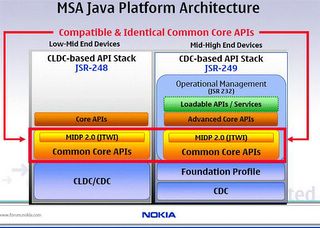
If you read about Nokias S60 platform
"During 2006 the S60 platform will also offer rich UI support matching native capabilities (eSWT) and J2SE compatible API subset (CDC/FP)"
As I understand, Nokia will support Foundation Profile 1.1, but the graphics toolkit is not going to be based on J2ME/Personal Profile & J2ME/Personal Basis Profile, it would be based on eSWT instead.
The J2ME/Personal Profile is essentially a graphics package, a subset of AWT. It is a superset of Basis Profile, which is a graphics packaged based on the Xlet model. Basis Profile is a superset of the Foundation Profile, which supports the basic core classes, but no graphics package.
It look to me that the J2ME/Personal Profile and J2ME/Personal Basis Profiles won't be used anymore on Nokia devices. Instead we're going to have eSWT over Foundation Profile 1.1, that is, you get a (much) better windowing toolkit , but also get a very complete subset of J2SE 1.4.2, which is exactly what J2ME/Personal Profile 1.1 is.
But I am not sure about that, what is your option?
Is J2ME/Personal Profile a dead product?
If companies like Nokia start to not support J2ME/Personal Profile, then J2ME/Personal Profile will be dead product, that is my personal opinion.
update no 1: I agree with the comments from Björn C, JSR-249 should include GUI functions other than what’s in MIDP like eSWT or/and J2ME/Personal Profile.
update no 2: comments from Martin Ryzl, Sun in the Netbeans team: JSR-249 is not about UI toolkit - it's kind of standardization of APIs based on CDC configuration, similar to JSR-248 for CLDC.
Speaking about UI toolkits, you should look at JSR-209 (aka AGUI) which is a subset of Swing for CDC. We will support this technology together with Personal Profile (awt).
eSWT is not a JCP standard, thus it cannot be part of JSR-249 and until it is standardized through jcp process we won't support it.
update no 3: anonymous-comment talk about confusion and I could only agree, for me it look like Nokia will drop support for J2ME/Personal Profile and go for eSWT, if it is correct I don't now, only Nokia now.
update no 4: There are some different UI toolkits for the J2ME/CDC platform.We have awt (Personal Profile), we also have AGUI (JSR-209) which is a subset of Swing for CDC. Both are standardized through the jcp process. Nokia talk about eSWT and it is not a JCP standard, any plans standardized eSWT through the jcp process ? Will Nokia only support eSWT for the J2ME/CDC platform in the future?
I think there it is a little confusing in this UI toolkit area!
I think it would be great if Nokia could clarify this matter.
If you read about Nokias S60 platform
"During 2006 the S60 platform will also offer rich UI support matching native capabilities (eSWT) and J2SE compatible API subset (CDC/FP)"
As I understand, Nokia will support Foundation Profile 1.1, but the graphics toolkit is not going to be based on J2ME/Personal Profile & J2ME/Personal Basis Profile, it would be based on eSWT instead.
The J2ME/Personal Profile is essentially a graphics package, a subset of AWT. It is a superset of Basis Profile, which is a graphics packaged based on the Xlet model. Basis Profile is a superset of the Foundation Profile, which supports the basic core classes, but no graphics package.
It look to me that the J2ME/Personal Profile and J2ME/Personal Basis Profiles won't be used anymore on Nokia devices. Instead we're going to have eSWT over Foundation Profile 1.1, that is, you get a (much) better windowing toolkit , but also get a very complete subset of J2SE 1.4.2, which is exactly what J2ME/Personal Profile 1.1 is.
But I am not sure about that, what is your option?
Is J2ME/Personal Profile a dead product?
If companies like Nokia start to not support J2ME/Personal Profile, then J2ME/Personal Profile will be dead product, that is my personal opinion.
update no 1: I agree with the comments from Björn C, JSR-249 should include GUI functions other than what’s in MIDP like eSWT or/and J2ME/Personal Profile.
update no 2: comments from Martin Ryzl, Sun in the Netbeans team: JSR-249 is not about UI toolkit - it's kind of standardization of APIs based on CDC configuration, similar to JSR-248 for CLDC.
Speaking about UI toolkits, you should look at JSR-209 (aka AGUI) which is a subset of Swing for CDC. We will support this technology together with Personal Profile (awt).
eSWT is not a JCP standard, thus it cannot be part of JSR-249 and until it is standardized through jcp process we won't support it.
update no 3: anonymous-comment talk about confusion and I could only agree, for me it look like Nokia will drop support for J2ME/Personal Profile and go for eSWT, if it is correct I don't now, only Nokia now.
update no 4: There are some different UI toolkits for the J2ME/CDC platform.We have awt (Personal Profile), we also have AGUI (JSR-209) which is a subset of Swing for CDC. Both are standardized through the jcp process. Nokia talk about eSWT and it is not a JCP standard, any plans standardized eSWT through the jcp process ? Will Nokia only support eSWT for the J2ME/CDC platform in the future?
I think there it is a little confusing in this UI toolkit area!
I think it would be great if Nokia could clarify this matter.
Sunday, February 26, 2006


Wednesday, February 22, 2006
Tar problem med J2ME slut i och med JSR-232?
Hoppas det!!
Ett av problemen som Java utvecklare för J2ME plattformen bråttas med har varit alla buggar som funnits och svårigheten med att kunna uppgradera Java versionen i respektive telefon.
Nu är JSR 232: Mobile Operational Management på väg in i Nokia’s S60 plattform.
Resultatet blir:
1) Java stöd i mobiler för både J2ME/MIDP och J2ME/Personal Profile som dessutom har stöd för MSA som innebär en enhetlig javaplattform som spänner över många mobiler och mobiltelefontillverkare och som därmed innehåller alla bra Java API:er som vi Java utvecklare har väntat på länge.
2) Det kommer gå att på en enkelt & säkert sätt uppgradera Java plattformen i och med JSR-232
Så här säger Nokia:
During 2006 the S60 platform will be bringing even more opportunity to Java developers with the JSR 248, Mobile Service Architecture for CLDC, compatibility. JSR 248 will introduce predictable set of Core APIs and roadmap for the developers how the Core API set will develop in future. Another important introduction is JSR 232 - Mobile Operational Management, which will allow the Java capabilities of S60 platform devices to be managed both locally and remotely with a modular architecture that enables extensibility after manufacturing. During 2006 the S60 platform will also offer rich UI support matching native capabilities (eSWT) and J2SE compatible API subset (CDC/FP).The Java implementation on the S60 platform shares many common features with the implementation on theSeries 40 Platform and the Series 80 Platform. This allows developers to easily extend their applications' reach to the entire platform range.
Hittade denna fina sammanfattning av JSR-232, JSR-248 och JSR-249:
All major mobile phone manufacturers worked together in order to define a 'Mobile Operational Management' concept (JSR-232). The OSGi Service Platform and the OMA DM (JSR-246) specifications provide the basis for building this standard for end-to-end management of CDC-enabled mobile handsets. JSR-248/249 go beyond the basic JSR-232 specification. Together these build a solid base for development of middleware in form of OSGi bundles on all kinds of mobile devices - thus enabling network operators and service providers to remotely manage any kind of services on the target. The well-known OSGi concepts of remote management and maintenance of the whole software lifecycle are applied to the world of mobile phones. The upcoming OSGi Release 4 specifications are going to further finegrain the corresponding APIs in order to best-fit each platform and profile and harmonize the different JSRs.For users, who want to install new software the new approach will simplify downloads dramatically. A complete set consisting of all required components/codecs may be dynamically packaged for the specific phone, downloaded and installed in the background while the phone is still in use. Security during download and operation is significantly increased. For developers, the numerous new APIs and runtime features e.g. for message queuing and connectivity will make it easier to write feature-rich applications and enable inter-phone and server-driven applications. Packaging of applications will become a lot simpler than nowadays.
Ett av problemen som Java utvecklare för J2ME plattformen bråttas med har varit alla buggar som funnits och svårigheten med att kunna uppgradera Java versionen i respektive telefon.
Nu är JSR 232: Mobile Operational Management på väg in i Nokia’s S60 plattform.
Resultatet blir:
1) Java stöd i mobiler för både J2ME/MIDP och J2ME/Personal Profile som dessutom har stöd för MSA som innebär en enhetlig javaplattform som spänner över många mobiler och mobiltelefontillverkare och som därmed innehåller alla bra Java API:er som vi Java utvecklare har väntat på länge.
2) Det kommer gå att på en enkelt & säkert sätt uppgradera Java plattformen i och med JSR-232
Så här säger Nokia:
During 2006 the S60 platform will be bringing even more opportunity to Java developers with the JSR 248, Mobile Service Architecture for CLDC, compatibility. JSR 248 will introduce predictable set of Core APIs and roadmap for the developers how the Core API set will develop in future. Another important introduction is JSR 232 - Mobile Operational Management, which will allow the Java capabilities of S60 platform devices to be managed both locally and remotely with a modular architecture that enables extensibility after manufacturing. During 2006 the S60 platform will also offer rich UI support matching native capabilities (eSWT) and J2SE compatible API subset (CDC/FP).The Java implementation on the S60 platform shares many common features with the implementation on theSeries 40 Platform and the Series 80 Platform. This allows developers to easily extend their applications' reach to the entire platform range.
Hittade denna fina sammanfattning av JSR-232, JSR-248 och JSR-249:
All major mobile phone manufacturers worked together in order to define a 'Mobile Operational Management' concept (JSR-232). The OSGi Service Platform and the OMA DM (JSR-246) specifications provide the basis for building this standard for end-to-end management of CDC-enabled mobile handsets. JSR-248/249 go beyond the basic JSR-232 specification. Together these build a solid base for development of middleware in form of OSGi bundles on all kinds of mobile devices - thus enabling network operators and service providers to remotely manage any kind of services on the target. The well-known OSGi concepts of remote management and maintenance of the whole software lifecycle are applied to the world of mobile phones. The upcoming OSGi Release 4 specifications are going to further finegrain the corresponding APIs in order to best-fit each platform and profile and harmonize the different JSRs.For users, who want to install new software the new approach will simplify downloads dramatically. A complete set consisting of all required components/codecs may be dynamically packaged for the specific phone, downloaded and installed in the background while the phone is still in use. Security during download and operation is significantly increased. For developers, the numerous new APIs and runtime features e.g. for message queuing and connectivity will make it easier to write feature-rich applications and enable inter-phone and server-driven applications. Packaging of applications will become a lot simpler than nowadays.
Java EE5 -- har kommit!
Java EE5 har kommit!
I alla fall en beta version av Java EE 5 finns att ladda ner kallad Java EE 5 SDK Preview.
Dessutom finns Netbeans 5.5 beta med Java EE5 stöd att ladda ner, den
kallas Preview: NetBeans IDE 5.5 with NetBeans Enterprise Pack , som innehåller:
- NetBeans 5.5 Preview with Java EE 5 support
- NetBeans Enterprise Pack 5.5 Preview with BPEL, XML, and UML support
- Sun Java System Application Server PE 9 Beta
*****************************************************************************************
This preview gives developers an early look at a collection of tools that enable Java EE5 development and creation of Service Oriented Architecture
(SOA) applications. It is all here in a special one-time bundle integrated with the NetBeans IDE 5.5 Preview: UML Modeling, Visual Design Tools for SOA Architects, and Java EE 5 SDK Preview.
This special sneak peek is available for those of you who want to get a head start designing and developing next generation Java EE5 and SOA applications. Our goal is to make it easier for you to model, implement, and deploy Web services, business processes, and SOA architectures with the best new tools we have to offer -- all in one preview release made available to the NetBeans community.
***************************************************************************************
I alla fall en beta version av Java EE 5 finns att ladda ner kallad Java EE 5 SDK Preview.
Dessutom finns Netbeans 5.5 beta med Java EE5 stöd att ladda ner, den
kallas Preview: NetBeans IDE 5.5 with NetBeans Enterprise Pack , som innehåller:
- NetBeans 5.5 Preview with Java EE 5 support
- NetBeans Enterprise Pack 5.5 Preview with BPEL, XML, and UML support
- Sun Java System Application Server PE 9 Beta
*****************************************************************************************
This preview gives developers an early look at a collection of tools that enable Java EE5 development and creation of Service Oriented Architecture
(SOA) applications. It is all here in a special one-time bundle integrated with the NetBeans IDE 5.5 Preview: UML Modeling, Visual Design Tools for SOA Architects, and Java EE 5 SDK Preview.
This special sneak peek is available for those of you who want to get a head start designing and developing next generation Java EE5 and SOA applications. Our goal is to make it easier for you to model, implement, and deploy Web services, business processes, and SOA architectures with the best new tools we have to offer -- all in one preview release made available to the NetBeans community.
***************************************************************************************
Subscribe to:
Posts (Atom)